For bag brands, wholesalers, distributors, and retailers, a logo is more than a decorative detail. It is a visible representation of brand identity, product positioning, and perceived quality. Whether applied to a tactical backpack, travel bag, canvas tote, or everyday carry pack, the right branding method helps turn a standard product into a recognizable branded item.
However, choosing a branding technique involves more than deciding how a logo should look. Fabric composition, surface texture, product construction, logo complexity, expected usage, order quantity, and production costs all influence the final result.
As an experienced bag and backpack manufacturer, we recommend evaluating branding options during product development rather than treating them as a finishing step. This approach helps ensure that the selected method is compatible with the bag material, suitable for bulk production, and consistent with the brand’s quality requirements.
This guide explains the main Custom Bag Branding options, including logo printing, embroidery, woven labels, and rubber or PVC patches. It also covers material compatibility, sample approval, production considerations, and quality control to help B2B buyers make informed decisions.
1. What Is Custom Bag Branding?
Custom Bag Branding refers to the process of applying a company’s logo, brand name, visual identity, or product information to bags and backpacks through customized printing, embroidery, labels, patches, and other branding components.
For manufacturers, branding is not simply about placing a logo on an existing product. It involves selecting an appropriate application method, preparing the artwork, coordinating the logo position with the bag structure, and controlling the finished appearance during production.
1.1 Common Types of Bag Branding
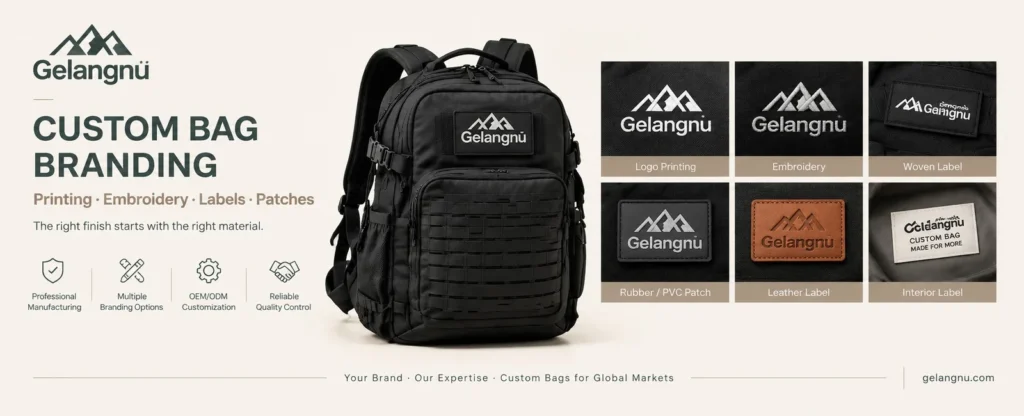
The most frequently used branding methods include:
- Logo printing:Applies graphics directly to a suitable fabric or surface using screen printing, heat transfer, or digital printing.
- Embroidery:Uses stitched threads to create a raised, textured logo.
- Woven labels:Integrates brand names or logos into a separately manufactured textile label.
- Rubber and PVC patches:Creates dimensional branding components that can be attached to the bag.
- Leather and synthetic leather labels:Adds a distinctive material-based branding detail through embossing, debossing, printing, or engraving.
Each method creates a different visual effect and has its own manufacturing requirements. The right choice depends on the product design, material, intended application, and budget.
1.2 Where Can Logos Be Applied on Bags and Backpacks?
Branding can be incorporated into different parts of a bag, depending on its construction and intended appearance.
Common locations include:
- Front panels:A highly visible location for primary brand logos.
- Exterior pockets:Suitable for smaller logos or secondary brand details.
- Side panels:Often used for woven labels or compact patches.
- Shoulder straps and webbing:Useful for subtle branding on backpacks and tactical bags.
- Interior lining:Suitable for brand labels, care labels, and product information.
- Zipper pulls and accessories:Can incorporate customized logo details into smaller components.
- Hang tags and packaging:Provide additional opportunities to communicate brand identity.
Logo placement should be considered alongside pocket dimensions, seams, zippers, reinforcement areas, and other structural elements. A location that looks suitable in a digital design may not be practical once the bag is assembled.
1.3 Why Branding Should Be Planned During Product Development
Branding decisions can influence several stages of bag manufacturing.
For example, embroidery is often easier to complete before a panel is assembled into a complicated bag structure. A woven label may need to be inserted into a seam during sewing. A PVC patch may require a dedicated attachment area, while a printed logo needs a suitable surface for consistent application.
Planning these details early helps manufacturers determine:
- Which production stage should handle the branding process.
- Whether the selected material is suitable for the chosen technique.
- How much space is needed around the logo.
- Whether additional backing, reinforcement, or attachment components are required.
- How branding will affect production time and cost.
For B2B buyers, early confirmation also reduces unnecessary sample revisions and makes bulk production specifications easier to control.
2. Logo Printing Options for Custom Bags
Logo printing is one of the most widely used approaches to custom bag branding. It allows brands to apply names, symbols, graphics, and other visual elements directly to suitable bag surfaces.
Different printing techniques produce different results. The choice should be based on artwork requirements, fabric characteristics, production quantity, and expected product use.
2.1 Screen Printing
Screen printing transfers ink onto a material through a prepared mesh screen. Specific areas of the screen allow ink to pass through, forming the intended design on the surface.
It is commonly considered for canvas bags, cotton bags, polyester fabrics, and selected other textile materials.
Main advantages:
- Suitable for relatively simple logos and graphic designs.
- Practical for repeat production.
- Can produce clear, solid-color graphics.
- Offers a range of ink and finish options depending on the material.
Manufacturing considerations:
Screen printing requires attention to screen preparation, ink selection, printing pressure, and curing conditions. The fabric surface and any coating can affect ink adhesion and the final appearance.
For designs involving several colors, accurate registration between colors is also important. Buyers should confirm the expected color result on the actual production fabric rather than relying exclusively on a digital artwork preview.
2.2 Heat Transfer Printing
Heat transfer printing applies a pre-produced design to a material using controlled heat and pressure.
Depending on the transfer technology, it can reproduce detailed graphics, multiple colors, and smaller design elements that may be difficult to achieve with some conventional printing methods.
Main advantages:
- Suitable for detailed logo designs.
- Can reproduce multicolor graphics.
- Offers flexibility for selected synthetic fabrics.
- Can be considered for certain smaller production runs.
Manufacturing considerations:
The material must be compatible with the required temperature and pressure. Excessive heat may affect some synthetic fabrics, coatings, or laminated surfaces.
The transfer material and application conditions also influence adhesion and appearance. Before bulk production, the manufacturer should verify that the transfer is properly bonded and that the finished surface meets the agreed requirements.
2.3 Digital Printing
Digital printing uses digital artwork to produce graphics on compatible materials. It is particularly useful when a design contains multiple colors, gradients, or detailed visual elements.
Main advantages:
- Supports complex artwork.
- Suitable for certain multicolor designs.
- Reduces the need for traditional screen preparation.
- Can offer flexibility for shorter production runs, depending on the equipment and material.
Manufacturing considerations:
Not every digital printing process works on every fabric. Material preparation, ink compatibility, surface texture, and color management all affect the result.
Buyers should also consider whether the printing process can deliver consistent colors and image quality across the intended production quantity.
2.4 How to Choose the Right Printing Method
The best printing method depends on several practical factors.
|
Selection factor |
What buyers should consider |
|
Logo complexity |
Simple logos and detailed multicolor graphics may require different processes |
|
Number of colors |
Color count can affect setup, production time, and cost |
|
Fabric type |
Nylon, polyester, canvas, and coated fabrics have different surface properties |
|
Durability requirements |
Consider abrasion, washing, handling, and intended usage |
|
Order quantity |
Setup costs and production efficiency vary by method |
|
Budget |
Compare the total branding cost rather than looking only at the application price |
From a manufacturer’s perspective, the most suitable printing technique is not necessarily the one that reproduces the most complicated artwork. It is the one that achieves the required visual result and practical performance on the selected material while remaining consistent in production.
3. Embroidery: A Textured Branding Option for Bags and Backpacks
Embroidery creates a logo by stitching colored threads directly onto a fabric surface. Unlike printing, which produces a relatively flat graphic, embroidery adds texture and dimension.
It is commonly used on backpacks, canvas bags, sports bags, outdoor products, and other fabric-based accessories.
3.1 How Logo Embroidery Works
Before embroidery begins, the logo artwork is converted into a machine-readable stitch file through a process known as digitizing.
The digitizing process determines how the machine will reproduce the design, including:
- Stitch types and directions.
- Thread colors.
- Stitch density.
- Stitch sequence.
- Underlay and backing requirements.
The quality of the finished logo depends not only on the artwork but also on how the design is translated into stitches.
A logo that looks clear on a computer screen may require adjustments before it can be embroidered successfully. Very small text, thin lines, and intricate details can be difficult to reproduce accurately with thread.
3.2 Advantages of Embroidered Logos
Embroidery offers several benefits for suitable bag designs:
- Textured appearance:Stitched threads create a raised surface that makes the logo visually distinctive.
- Strong brand presence:Embroidered logos can give backpacks and bags a more substantial, traditional appearance.
- Color flexibility:Different thread colors can be combined to reproduce many logo designs.
- Versatile applications:Embroidery can be used on many woven fabrics, provided the material and construction are suitable.
For brands developing premium-looking backpacks, outdoor bags, or corporate merchandise, embroidery can be an attractive branding option.
3.3 Limitations and Production Considerations
Embroidery is not suitable for every logo or fabric.
Small details may lose clarity. Fine lettering, narrow gaps, and complex graphics may not reproduce accurately at small sizes.
Fabric stability matters. Lightweight or thin materials may stretch, pucker, or distort during embroidery if they are not properly supported.
Backing may be necessary. Stabilizing materials can help control fabric movement and improve stitch quality. The appropriate backing depends on the fabric and design.
Stitch count affects cost. Larger or more complicated designs generally require more stitches and machine time.
Before confirming embroidery for bulk production, buyers should review the digitized design and a physical sample made on the intended material.
3.4 When Should Brands Choose Embroidery?
Embroidery is worth considering when:
- The brand wants a raised, textured logo.
- The product uses a suitable woven fabric.
- The logo has enough space and detail to be reproduced clearly.
- The intended appearance supports a premium or traditional brand image.
For very detailed logos or lightweight materials, printing or a separate label may provide a more suitable alternative.
4. Custom Labels and Patches for Bag Branding
Labels and patches provide another flexible way to incorporate brand identity into bags and backpacks. Unlike direct printing or embroidery, these components are manufactured separately and then attached to the product.
They can also create a distinctive appearance through different materials, textures, shapes, and finishing methods.
4.1 Woven Labels
Woven labels are produced by weaving threads into a textile structure to form a brand name, logo, or other information.
They are commonly used on:
- Backpack side seams.
- Interior brand panels.
- Pocket edges.
- Shoulder straps.
- Bag lining and other textile areas.
Advantages:
- A clean textile appearance.
- Suitable for brand names and relatively compact logos.
- Can be produced in different shapes and sizes.
- Works well for both interior and exterior branding.
Manufacturing considerations:
The label’s dimensions, edge treatment, background color, and attachment position should be confirmed before production. Very small text and intricate details may need to be simplified to maintain readability.
Buyers should also decide whether the label will be folded, inserted into a seam, or sewn flat onto the bag.
4.2 Printed Labels
Printed labels apply text, logos, or product information to a suitable label material through printing.
They are often used for:
- Brand identification.
- Care instructions.
- Product information.
- Material and composition details.
- Manufacturing or compliance information where required.
Printed labels are useful when a product needs more text than can be comfortably displayed on a small woven label.
The choice of label material and printing process should reflect the intended use, required readability, and expected exposure to handling or washing.
4.3 Rubber and PVC Patches
Rubber and PVC patches are popular for tactical backpacks, outdoor bags, sports bags, and utility products.
They can be manufactured with raised or recessed details, multiple colors, and different shapes to create a dimensional logo.
Advantages:
- Distinctive three-dimensional appearance.
- Suitable for bold logos and graphic symbols.
- Can be customized in different shapes, colors, and thicknesses.
- Offers a practical branding option for many outdoor and tactical-style products.
Manufacturing considerations:
The patch design should account for its dimensions, thickness, flexibility, and attachment method. Small text and very fine graphic details may require adjustment to ensure they remain recognizable.
The patch should also be positioned on a suitable area of the bag. For example, a front panel may provide a practical attachment location, while a curved or heavily padded area may require additional consideration.
4.4 Leather and Synthetic Leather Labels
Leather and synthetic leather labels are often used on lifestyle bags, дорожные сумки, canvas products, and selected backpacks.
Common customization methods include:
- Embossing: Creates raised details on the label surface.
- Debossing: Presses the logo into the material to create a recessed impression.
- Printing: Applies color or graphic details to the surface.
- Engraving: Uses a suitable process to mark the material.
These labels can add a distinctive material contrast to a bag. However, genuine leather and synthetic leather have different properties, so the selected material and marking process should be evaluated together.
4.5 How Are Labels and Patches Attached to Bags?
The attachment method influences both appearance and practical performance.
|
Attachment method |
Typical application |
Manufacturing considerations |
|
Sew-on |
Woven labels, leather labels, fabric patches |
Stitching position, seam allowance, and edge finishing |
|
Heat application |
Selected heat-compatible labels and patches |
Temperature, pressure, and surface compatibility |
|
Hook-and-loop backing |
Removable tactical and outdoor patches |
Panel design, attachment strength, and intended use |
|
Rivets or mechanical fasteners |
Selected decorative or structural patches |
Material thickness, reinforcement, and hardware positioning |
Not every attachment method is appropriate for every label or bag material. The manufacturer should confirm the method during sample development and verify that it does not interfere with the bag’s structure or intended function.
5. Custom Bag Branding Methods: How Do They Compare?
Each branding technique has a different visual effect, manufacturing process, and cost structure. The following comparison provides a practical starting point for B2B buyers.
|
Branding method |
Visual effect |
Suitable applications |
Key considerations |
|
Screen printing |
Flat, clean graphic |
Canvas and selected fabric bags |
Ink adhesion and color consistency |
|
Heat transfer |
Smooth, detailed graphic |
Compatible synthetic fabrics |
Heat compatibility and bonding |
|
Digital printing |
Detailed, multicolor design |
Suitable fabric surfaces |
Material compatibility and color control |
|
Embroidery |
Raised, textured logo |
Backpacks and fabric bags |
Stitch density and fabric stability |
|
Woven label |
Integrated textile appearance |
Interior and exterior branding |
Label dimensions and attachment |
|
Rubber/PVC patch |
Raised, dimensional appearance |
Tactical and outdoor bags |
Mold design and attachment |
|
Leather label |
Distinctive material appearance |
Lifestyle and travel bags |
Material selection and finishing |
There is no universally best branding method. A detailed multicolor logo may be better suited to a compatible printing process, while a simple symbol may look more distinctive as embroidery or a PVC patch.
The final selection should balance appearance, material compatibility, durability expectations, production efficiency, and total cost.
6. How to Select the Right Branding Method for Different Bag Materials
The same branding technique can produce different results on different fabrics. Material selection should therefore be part of the branding decision.
6.1 Nylon and Polyester Bags
Nylon and polyester are widely used in backpacks, sports bags, travel bags, and outdoor products.
Potential branding options include:
- Screen printing on suitable surfaces.
- Heat transfer where the material can tolerate the required temperature.
- Embroidery on fabrics with adequate stability.
- Woven labels and rubber or PVC patches.
One important consideration is that some nylon and polyester fabrics have coatings, water-resistant treatments, or laminated surfaces. These treatments may affect ink adhesion, heat application, or patch attachment.
A sample test on the actual production material is recommended before confirming the process.
6.2 Canvas and Cotton Bags
Canvas and cotton are common materials for tote bags, casual backpacks, promotional bags, and lifestyle products.
Suitable branding options may include:
- Screen printing.
- Woven labels.
- Leather or synthetic leather patches.
The fabric’s weave, thickness, and surface texture can influence the final result. For example, a rough canvas surface may affect the appearance of fine printed details, while a thin cotton fabric may require stabilization for embroidery.
6.3 Oxford Fabric and Tactical Backpacks
Oxford fabric is frequently used in tactical backpacks, outdoor bags, utility packs, and travel products.
Depending on the fabric construction and coating, branding options may include printing, embroidery, woven labels, and rubber or PVC patches.
For tactical-style products, PVC patches are often considered because their dimensional appearance complements MOLLE webbing, hook-and-loop panels, and other modular design details.
However, the branding location must be coordinated with the bag’s structure. A patch should not interfere with webbing attachment points, pocket access, seams, or functional components.
6.4 PU and Synthetic Leather Bags
PU and other synthetic leather materials are used in lifestyle bags, fashion accessories, and selected travel products.
Possible branding approaches include:
- Embossed or debossed labels.
- Printing on compatible surfaces.
- Engraved or marked patches where appropriate.
- Sewn-on synthetic leather labels.
Surface coatings and textures can affect how a logo appears and how well it remains attached. The selected process should be tested on the actual material rather than assumed to work based on its general material category.
7. What Should Buyers Confirm Before Ordering Custom Branded Bags?
For brands and wholesalers, a successful custom branding project starts with clear production specifications. Providing complete information before sampling helps manufacturers evaluate feasibility and reduces unnecessary revisions.
7.1 Provide Production-Ready Logo Artwork
Buyers should provide the highest-quality logo files available.
Commonly preferred formats include:
- AI or EPS vector files.
- Editable PDF files.
- High-resolution PNG files where appropriate.
Vector artwork is especially useful when a logo needs to be resized without losing edge clarity.
If color accuracy is important, provide Pantone references or another agreed color standard. The manufacturer can then assess the most suitable way to reproduce the intended colors using the selected branding process.
7.2 Confirm Logo Size and Placement
Do not rely only on statements such as “place the logo on the front.”
Provide clear specifications, including:
- Logo width and height.
- Distance from the top, bottom, or side edges.
- Position relative to seams, pockets, and zippers.
- Orientation and alignment.
- Required spacing around the logo.
A marked-up product image, technical drawing, or placement diagram can make these requirements easier to understand.
7.3 Request a Branding Sample
A digital mockup helps communicate the intended appearance, but it cannot fully demonstrate the finished result.
A physical sample allows buyers to check:
- Logo dimensions and placement.
- Color accuracy.
- Print clarity or embroidery quality.
- Label and patch finishing.
- Attachment quality.
- Compatibility with the actual bag material.
The approved sample should serve as a reference for bulk production.
If the logo design, material, or attachment method changes after approval, the revised version should be reviewed before production continues.
7.4 Confirm Durability Requirements
Different branding methods have different performance characteristics. Buyers should explain how the finished bag will be used so that the manufacturer can recommend appropriate materials and processes.
Depending on the product, relevant considerations may include:
- Surface abrasion.
- Repeated handling.
- Washing or cleaning exposure.
- Peeling or edge separation.
- Thread loosening.
- Cracking or deformation.
Any testing requirements should be agreed upon in advance. Avoid assuming that a branding method is automatically suitable for every environment simply because it looks correct on a new sample.
7.5 Clarify MOQ, Cost, and Production Lead Time
Branding methods can affect the overall manufacturing cost in different ways.
For example:
- Screen printing may involve screen preparation.
- Embroidery may require digitizing and machine time.
- PVC patches may involve mold or tooling costs.
- Custom labels may have their own minimum production quantities.
- Special materials or attachment methods may require additional processing.
When requesting a quotation, buyers should confirm whether these setup costs are included in the unit price or charged separately.
It is also important to clarify how artwork confirmation, branding sample approval, and any tooling preparation will affect the production schedule.
8. Quality Control for Custom Bag Branding in Bulk Production
Branding quality should be included in the overall bag quality control process. A well-constructed backpack can still fall short of brand expectations if its logo is poorly positioned, inconsistent, or incorrectly attached.
For manufacturers, the objective is to ensure that bulk production follows the approved artwork, sample, and technical specifications.
8.1 Logo Position and Alignment
Inspect the logo against the approved placement reference.
Check for:
- Consistent distance from panel edges.
- Correct horizontal and vertical alignment.
- Consistent placement across production units.
- Adequate clearance from seams, zippers, and other components.
8.2 Color and Appearance Consistency
Compare finished branding with the approved sample and agreed color references.
For printing, check ink coverage, color appearance, and registration.
For embroidery, inspect thread colors, stitch density, and overall logo shape.
For labels and patches, check material color, surface finish, dimensions, and edge quality.
8.3 Attachment and Finishing Quality
Inspect the way each branding component is attached to the bag.
Look for:
- Loose or uneven stitching.
- Unfinished or fraying label edges.
- Peeling or lifting patches.
- Uneven bonding.
- Damaged fabric around the branding area.
- Visible defects caused during application.
The inspection should consider both the appearance of the branding and its integration with the finished bag.
8.4 Branding Durability Checks
Where required, conduct suitable checks based on the branding method and product application.
Examples include:
- Abrasion checks for printed surfaces.
- Adhesion checks for heat-applied transfers and patches.
- Stitch inspection for embroidered logos and sewn labels.
- Appropriate cleaning or washing tests when relevant to the product.
Testing methods and acceptance criteria should be agreed upon before bulk production. Inspection records can also help maintain consistency across repeat orders.
9. Custom Bag Branding for OEM and ODM Manufacturing
For B2B buyers, branding is usually part of a larger product development and manufacturing project. OEM and ODM arrangements provide different ways to incorporate brand identity into a finished bag.
9.1 OEM Branding: Manufacturing According to Your Brand Specifications
In an OEM project, the buyer typically provides the product design or technical specifications, including branding requirements.
These may cover:
- Logo artwork and colors.
- Branding method.
- Logo dimensions and placement.
- Fabric and component specifications.
- Label and patch requirements.
- Packaging and product identification details.
The manufacturer’s role is to evaluate production feasibility, prepare samples, and manufacture the product according to the approved specifications.
9.2 ODM Branding: Integrating Brand Identity into Product Development
In an ODM project, branding can be incorporated while the product design is being developed or customized.
For example, a buyer may select an existing backpack concept and request adjustments to:
- Exterior logo placement.
- Label design.
- PVC patch shape and color.
- Interior brand labels.
- Fabric colors and customized components.
Integrating branding into the development stage helps ensure that the brand identity works naturally with the product’s structure and appearance.
9.3 Why Early Communication with Your Manufacturer Matters
Clear communication between the buyer and manufacturer helps avoid misunderstandings during development and production.
Before sampling, discuss the logo artwork, branding method, material compatibility, dimensions, placement, and attachment requirements.
Before bulk production, confirm the approved sample, final specifications, quality standards, and any additional branding-related costs.
This process helps reduce unnecessary revisions, improve production coordination, and maintain consistent brand presentation across product collections.
10. Conclusion: Build a Consistent Brand Identity Through the Right Custom Bag Branding
Choosing the right branding method is an important part of developing a successful custom bag or backpack.
Logo printing offers flexibility for graphic designs, embroidery creates a distinctive textured appearance, and woven labels, rubber or PVC patches, and leather labels provide additional ways to express brand identity.
However, the best option depends on more than appearance. Fabric compatibility, logo complexity, attachment methods, product usage, order quantity, and quality requirements all need to be considered.
For B2B buyers, the most reliable approach is to confirm branding specifications during product development, evaluate a physical sample, and include logo inspection in the bulk production quality control process.
At Gelangnu, we work with brands, wholesalers, and distributors on custom bag and backpack manufacturing projects. Our OEM/ODM services support branding requirements such as logo printing, embroidery, custom labels, and patches, depending on product design and material compatibility.
Looking to develop custom branded bags or backpacks for your business? Contact our team at info@gelangnu.com to discuss your product design, branding requirements, and bulk production needs.
Frequently Asked Questions About Custom Bag Branding
1. What is the best way to put a logo on a bag?
The best method depends on the bag material, logo design, desired appearance, and intended use. Printing works well for many graphic designs, embroidery creates a raised texture, and woven labels or PVC patches offer alternative branding styles. A sample on the actual production material is the best way to evaluate suitability.
2. Is embroidery or printing better for custom backpacks?
Neither method is universally better. Embroidery is suitable when a textured logo is desired and the fabric can support the stitching. Printing is often more practical for detailed or multicolor graphics, provided the fabric is compatible with the selected process.
3. Can I add my logo to a nylon or polyester backpack?
Yes. Nylon and polyester backpacks can support several branding options, including suitable printing methods, embroidery, woven labels, and rubber or PVC patches. However, coatings, fabric thickness, and surface treatments can affect compatibility, so testing on the actual material is recommended.
4. Are PVC patches suitable for tactical backpacks?
PVC patches are a common option for tactical-style backpacks because they can provide raised logo details and a distinctive appearance. They can be attached using methods such as sewing or hook-and-loop backing, depending on the design and intended application.
5. What logo file should I provide to a bag manufacturer?
AI, EPS, and editable PDF files are generally preferred for production artwork because they preserve scalable vector details. A high-resolution PNG may also be suitable for certain applications. Providing color references and the required logo dimensions helps the manufacturer prepare the branding sample.
6. Can I customize both the exterior logo and interior labels?
Yes. Many custom bag projects combine exterior branding, such as printing, embroidery, or patches, with interior woven or printed labels. Buyers should confirm all branding locations and specifications during product development so they can be incorporated into the manufacturing plan.
7. Does custom bag branding increase the MOQ?
It can, depending on the selected method and supplier’s production requirements. Custom molds, printing screens, embroidery setup, and label production may involve separate minimum quantities or setup costs. Buyers should confirm these details when requesting a quotation.